For us, every dream is like a seed that must be nurtured, cultivated, and protected so that it can blossom. Our commitment to managing environmental impacts and promoting the efficient use of natural resources is renewed every day. That is why Climate Change is one of the priority topics on the Company's ESG Strategic Agenda, which aims to build a path toward a low-carbon future based on a Climate Transition Plan detailed in Decarbonize Program.
In 2023, we reached a milestone in our decarbonization journey with the launch of Decarbonize Program, which consists of a solid foundation and ten pillars that reflect the main actions outlined in the Company's transition plan.
The ten pillars are governed by Commitment and Transparency in Information, Climate Risks and Opportunities, Innovation, and Leadership Development.
See each of the pillars below:
Pillars
1
Transition to a renewable energy matrix
2
Reduction in Carbon Intensity of Industrial Units
3
Transition to a new renewable fuel matrix
4
Development of low-carbon products
5
Development of suppliers of sustainable ingredients and packaging
6
Process Integration
7
Value chain engagement
8
Financial Investment with Positive Impact
9
Impactful and Positive Influence
10
Development of sustainable logistics operations
Commitment and Transparency in Information
Climate Risks and Opportunities
Innovation
Leadership development
Decarbonize Program is a company-wide program that involves the entire value chain. This program aims to mitigate and adapt to climate change. One of the success indicators of Decarbonize Program is the reduction of greenhouse gas (GHG) emissions, based on 2020, including Scope 1 and Scope 2 (purchasing approach).
The greenhouse gas (GHG) inventory, which follows the GHG Protocol Brazil methodology, has covered scopes 1, 2, and 3 since 2020 and is audited by a third-party company, reinforcing our commitment to transparency and reliability of information. This area also plays an important role in disseminating best practices and improving the organization's governance system, also contributing to the dissemination of knowledge to governance agents.
Practices and Projects
To achieve Descarbonize Program goals, we are investing in practices and projects that include:
Projects for transitioning the energy matrix to renewable and traceable energy
Research and investment in projects for transitioning to renewable fuels
Reduction of emissions in production processes with pilot units and specific decarbonization plans
Development of the value chain, based on the Alliance for the Future Program
Development of initiatives in packaging structures and supply chains
Development of actions aimed at low-carbon products
Reduction of waste destined for landfill
Allocation of financial resources to projects and initiatives that provide environmental and economic benefits for a low-carbon transition
Investments in forest preservation actions, contributing to the maintenance of CO2e stocks and sequestration
M. Dias Branco has been making progress in its decarbonization strategy, which encompasses all production units and the value chain. Monitored results are the absolute reduction in greenhouse gas emissions (tCO2e) and carbon intensity (tCO2e/ton produced) since 2020.
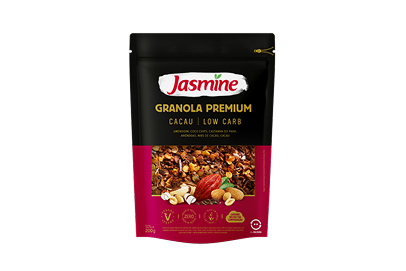
As another step in this journey, we have launched a pilot project for a carbon-neutral product, focusing on the unit located in Campina Grande do Sul, Paraná, which is a benchmark for healthy products.
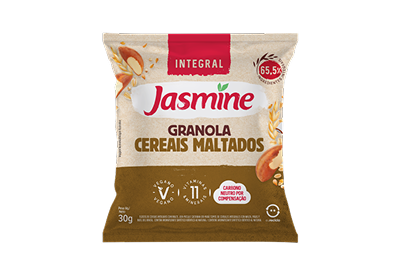
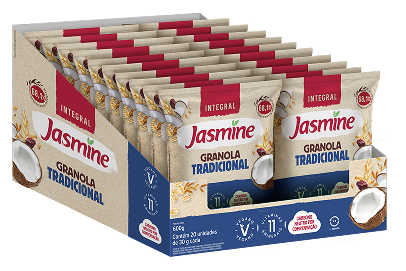
The operation chosen for calculating the carbon footprint was the Granola line from Jasmine brand.
Learn more on the topic
What is a Carbon Footprint?
A carbon footprint is a way of quantifying the impact of inputs, production processes, and outputs of a product system throughout its life cycle. This quantification is based on the calculation of carbon dioxide (CO2) emissions throughout its life cycle. Carbon dioxide (CO2) is one of the gases present in the atmosphere and is part of the so-called Greenhouse Gases (GHG).
What has M. Dias Branco been doing to reduce emissions?
M. Dias Branco has been moving forward with its decarbonization strategy, which encompasses all production units and the value chain.
Over the years, Campina Grande do Sul Unit, where the granola line is produced, has been developing environmental actions that have an impact on reducing greenhouse gas emissions, including:
Zero waste to landfill, which means that all waste is reused in some way.
Reduction in waste generation;
Use of 100% renewable energy in its energy matrix;
Implementation of reverse logistics for post-consumer packaging in partnership with “Eu reciclo” (I recycle), with traceability and information on which materials have been recycled;
Implementation of energy efficiency measures with an impact on carbon reduction.
Training for leaders responsible for decision-making, including concepts of decarbonization;
Implementation of management of refrigerant gases used in the production process.
How do we neutralize our emissions?
The emissions, not yet eliminated, existing in each granola bar and calculated in the carbon footprint were multiplied by the volume produced and 100% offset with support for the REDD+ Jari Pará project. The project chosen for neutralization involves a combination of activities, ranging from sustainable management and the promotion of agroextractivism, respecting the forest and providing employment and income for families in Vale do Jari. The Carbon Neutral by offsetting product project is also aligned with the investment with positive impact pillar. Because we understand that supporting projects related to reforestation and forest maintenance, and consequently reducing deforestation, has a direct impact on reducing global greenhouse gas emissions.
What are carbon credits?
Carbon credits are generated from projects that promote the preservation and restoration of natural areas, ensuring that the impact generated is reversed, for example, in forest conservation. Through the use of these certified credits, companies can neutralize their CO2 emissions.